Short-term vs. Long-term Leases: Which is Better for Your Brand?

You have taken a store with a short-term lease, but after 6 or 7 months, suddenly the rent hikes or the landlord decides to change the agreement terms. On the other hand, you have committed to a decade-long rental deed, but your business needs to expand. This could put financial stress and limit your ability to adapt.

Lease agreement decisions, whether for short-term or long-term, require careful evaluation, as the agreement directly impacts operational flexibility, brand reputation and overall budget.

If you are looking for commercial retail space for rent, it is essential to understand the trade-offs between short-term and long-term leases before signing the paperwork.

In this blog, we will help you get a clear picture of the type of lease that will suit your business needs.

What Is A Short-Term Lease?

A short-term lease is a rental agreement that typically lasts for about 6 months to 1 year. It allows the brands to adjust to the changes as per their needs without being tied to a long commitment.

For brands looking to test a new location, launch a pop-up store or explore seasonal sales opportunities, signing short-term deeds is the most preferred option.

Here are some of the advantages it offers.

  • Ability to experiment: It makes it easier for brands to try concepts, promotions and understand the market without any financial burden. As a result, they can refine their strategies before making larger investments.
  • Minimal risk exposure: In the fluctuating market, especially for start-ups which are still navigating the revenue forecast, short-term leases help to prevent long-term liabilities.
  • Scalable for growth: If the location is not working or you are planning to move to a large space, short leases allow for flexibility without any legal issues.
  • Lower financial commitment: In short-term rental agreements, one does not need to invest a large amount of money. As a result, brands can use the capital in marketing or inventory.

Now, let’s look at some of the drawbacks.

  • Instability: Temporary set-ups can give an impression to customers that the brand is not well-established.
  • Limited branding opportunities: Tenants opting for short-term leases are not allowed extensive renovations or customisation.
  • Higher costs: At times, the landlord might charge high rents for short commitments.

Understanding Long-Term Lease Agreements

A long-term lease agreement is a multi-year contract between the landlord and tenants, ranging from 5 to 10 years. It provides stability to brands with a strong consumer base and focuses on consistent growth.

When searching for commercial retail space for rent, established brands that want to build a strong brand presence and enhance consumer experience must opt for long-term lease agreements.

What Are The Advantages?

  • Customisable spaces: The retailers are allowed renovation, signage and other brand-specific improvements tailored to their requirements.
  • Predictable costs: Long-term leases include structured annual increases, which in turn simplify the budgeting process over time.
  • Stability: A long-term lease gives a permanent location to a business, which strengthens brand loyalty and brand recognition. As a result, customers associate the company with a reliable presence.

Are There Any Drawbacks?

  • Controlled flexibility: If the brand underperforms, breaking a long-term lease will incur penalties or additional charges.
  • Market risk: Changes in retail trends or consumer behaviour can make a long-term lease less advantageous.

Which Is The Right Choice?

When deciding on commercial retail space for rent, try to find out if the lease terms align with the brand identity, goals, objectives and budget allocation. Ask yourself the following questions.
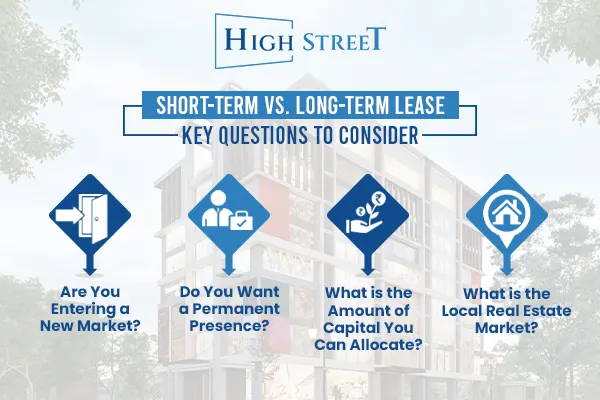
Short-term vs. Long-term Lease: Key Questions to Consider

  • Are You Entering a New Market Or Planning to Grow Your Established Business?
  • Do You Want a Permanent Presence To Build Trust?
  • What is the Amount of Capital You Can Allocate To Rent?
  • What is the Local Real Estate Market I.e., is It Rising, Declining or Stable?

Commercial Retail Space For Rent

Final Words

To conclude, there is no universal answer to choosing between a short-term or a long-term lease when it comes to commercial retail space. The key is to align your lease strategy with your business objectives, financial capacity and market conditions.

You can consider lease agreements at High Street. With the Completion Certificate scheduled for April 2026, the project offers a modern commercial environment that will help brands to become fully operational and expand their presence.