The rent you are quoted is not actually the cost you pay. Most of the time, the tenants, when considering retail space for lease, often negotiate the base rent. What they are not aware of is that the base rent is only a part of the financial picture.
There are, in fact, additional hidden costs like CAM charges, taxes and insurance, which most retailers overlook before finalising the paperwork. This significantly strains the financial budget and reduces profitability in the future.
Initially, one might find the base rent to be affordable; however, these extras in the lease terms eventually increase the obligations of the tenants.
If you are searching for retail space for lease, this blog is the right read for you. It breaks down what lies beyond basic rent and explains what every retailer should know.
Base rent is the total amount paid to the landlord for the right to use a retail space. It is calculated as a price set per square foot and forms the basis of the lease agreement. It is fixed and does not fluctuate over time, which makes it easy for tenants to calculate the budget.
It is important to understand that the base rent does not cover the expenses required for operating and maintaining the property. Additional costs such as CAM, insurance and property taxes are considered separate and usually change over time.
In simple words, we can say that the base rent gives tenants the right to use the property, but the cost of retail space for lease also includes these hidden expenses.
Common Area Maintenance, or CAM for short, is the charge paid by the retailers for the upkeep of the shared spaces, which can benefit all tenants but is not owned by a single unit.
CAM charges are calculated based on the square footage of the leased property relative to the entire area. This ensures fair contribution to the shared properties.
CAM expenses include the following.
Remember that CAM changes every year, depending on maintenance needs and the upgrading of the property. Some lease agreements include CAM caps that limit annual increases; however, it depends on the decision of the landlord.
Property taxes are levied by the government on the owners. In many retail lease agreements, especially triple net leases, the retailers are required to pay a portion of the property tax.
These taxes fluctuate depending on the changes in the property value and increases in the local tax. As a retailer, one might have little or no control over these costs.
Hence, when considering retail space for lease, make sure to know the following.
How often is the property reassessed?
Are there any recent tax increases?
Getting these answers will help you avoid unexpected financial burdens in the future.
Insurance is another component that is not included in the base rent. In some lease agreements, tenants are required to pay a specific amount of insurance money to maintain their coverage.
The agreements specify the minimum coverage limit and include clauses requiring tenants to list landlords as additional insured.
The three popular types of insurance include:
Before calculating the total expense, it is important to include the insurance amount, which can increase the total cost.
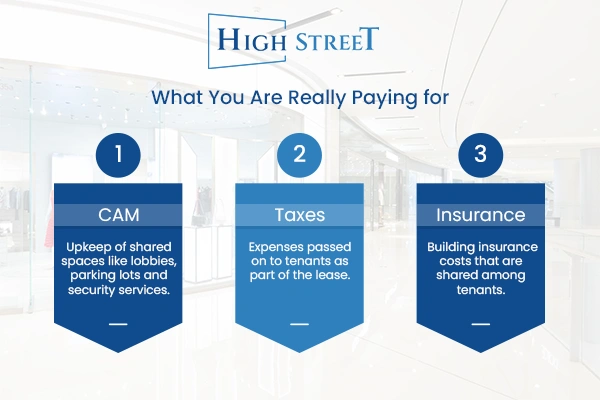
When assessing retail space for lease, look beyond the basic rent and take time to understand these components, which can help your retail business grow.
High Street, a vibrant ecosystem currently under development near the EM Bypass-Anandapur area, especially around Ruby General Hospital, always maintains transparency while renting space to retailers.